
The direct answer: you improve your Google Maps ranking by strengthening the same three things Google always ranks on — relevance, distance, and prominence — starting with your Google Business Profile, then reviews, then everything else. There’s no single hack. But there is a clear order of operations, and most businesses waste time on the wrong things first.
This guide gives you that order: what to fix this week, what to build over the next couple of months, and what compounds quietly in the background if you keep at it.
Why the Top 3 Positions Matter So Much
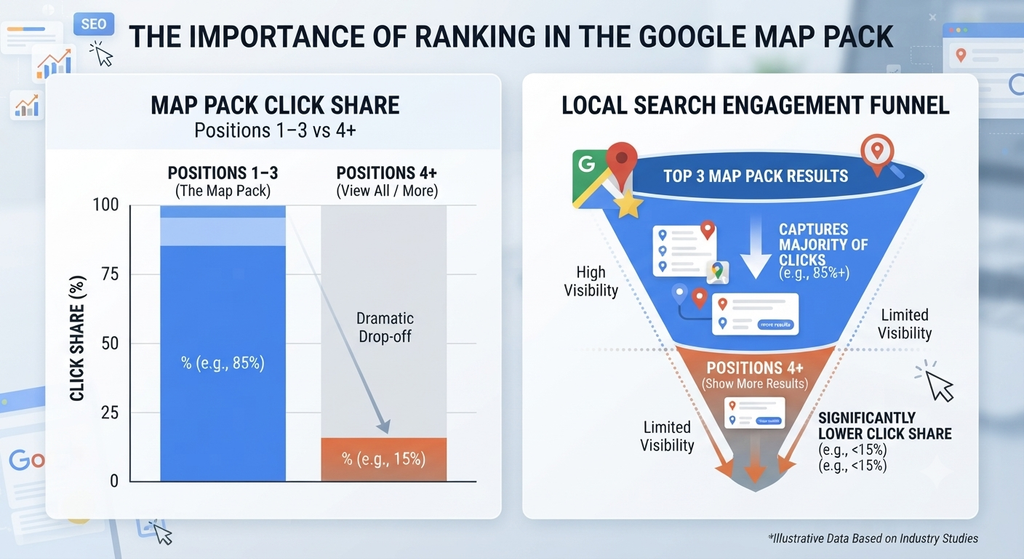
Google Maps shows a “local pack” — typically three highlighted businesses — for most local searches. The gap between position 3 and position 4 isn’t small: businesses in the top 3 map pack positions consistently capture a large majority of clicks, calls, and direction requests compared to everything below them, according to multiple local SEO click-through-rate studies. Being on page one of Maps but outside the top 3 often means being functionally invisible to most searchers, who rarely scroll or tap “more results.”
That’s why ranking improvement work should be judged by one question: does this move you toward the top 3 for the searches your actual customers use? Vanity metrics — total review count, follower numbers, generic keyword rankings — matter less than this.
Quick Wins (Week 1)
These take the least time and typically produce the fastest visible movement, because they directly close obvious relevance and completeness gaps.
- Fix your primary category. If it’s generic (“Doctor” instead of “Dentist,” “Store” instead of “Bakery”), correct it immediately — this is consistently identified as the single most influential local ranking factor.
- Complete every profile field. Hours, phone, website, service list, attributes, and description. An incomplete profile is filtered out of consideration for many relevant searches before ranking even comes into play.
- Fix NAP mismatches between your Google Business Profile, website, and any major directories (Justdial, Practo, 99acres, industry-specific platforms). Inconsistent name, address, or phone details weaken the trust signal Google uses to confirm your business is legitimate.
- Add at least 10–15 real photos if your profile has fewer. Photos are one of the strongest, easiest levers for both click-through rate and direction requests — businesses with photos get meaningfully more of both than businesses without.
- Respond to every unanswered review, positive and negative. This is a five-minute task that signals an active, engaged business.
Medium-Term Actions (Weeks 2–8)
These require more sustained effort but are where most of the real ranking movement happens for competitive searches.
Build a Steady Flow of Reviews — Not Just a Pile
Review recency now carries as much weight as review volume. A business with 15 reviews from the last two months typically outperforms a competitor with 100 reviews and nothing new in over a year — Google reads ongoing review activity as evidence of a currently operating, trusted business, not just a historically popular one.
- Ask for a review right after a good interaction, every time, not sporadically.
- Send the direct review link via WhatsApp or SMS — the channel Indian customers respond to fastest.
- Never buy reviews or use review-gating (filtering who gets asked based on how happy they seem) — both violate Google’s policies and put your listing at risk.
Clean Up and Build Local Citations
A citation — any online mention of your business name, address, and phone number — reinforces prominence and trust. Audit your listings on major Indian directories (Justdial, Sulekha, IndiaMART) and industry-specific platforms (Practo for clinics, 99acres/MagicBricks for real estate, CarDekho for auto businesses), correct any mismatched details, and add missing citations on the directories most relevant to your industry.
Strengthen On-Page Relevance on Your Website
Your Google Business Profile carries most of the weight in the map pack itself, but your website supports rankings in standard local organic results below it, and reinforces the relevance signals Google cross-references against your profile.
- Make sure your homepage and service pages mention your service area and core services in natural language, not just your GBP.
- If you serve multiple cities or neighborhoods, build a genuine, unique page for each — not a templated page with only the city name swapped.
- Add local business schema markup so Google can parse your NAP and hours directly from your site’s code.
Start Building Real Local Backlinks
Backlinks matter more for organic local rankings than for the map pack itself, but they reinforce prominence overall. Prioritize a handful of genuinely relevant local links over a large volume of low-quality ones:
- Chamber of commerce or local business association directories
- Sponsorships of local events, teams, or community initiatives
- Supplier or partner “find a dealer/provider” pages, if applicable to your industry
- Local news coverage for a genuinely newsworthy opening, milestone, or community contribution
A single link from a recognized local organization or publication typically carries more weight than dozens of generic directory submissions.
Ongoing Signals That Compound Over Time
These don’t move the needle in a single week, but neglecting them causes a slow, hard-to-diagnose decline — and maintaining them is what separates businesses that hold their position from ones that slip after an initial push.
- Behavioral signals (clicks, calls, direction requests): Google tracks how often your listing gets clicked, called, and navigated to relative to competitors appearing for the same searches. A more compelling listing — clear cover photo, visible phone number, an active booking or ordering link — earns more of this engagement, which reinforces its position over time. You influence this indirectly by making every part of your profile easier and more appealing to act on, not by trying to manipulate clicks directly.
- Posting cadence: A profile with regular Google Posts (weekly or biweekly) signals ongoing activity. Profiles that go quiet for months tend to see a gradual decline in impressions, separate from any change to the underlying business information.
- Response speed: If you use GBP messaging, Google tracks and can display your typical response time. Faster responses signal an engaged, active business and support both trust and conversion.
- Continued review flow and response: Treat this as permanent, not a one-time push — the businesses that hold top-3 positions long-term are the ones that keep the review and response habit going indefinitely.
The One Thing Most Businesses Get Wrong
Most businesses treat Google Maps ranking as a one-time setup task: fill in the profile, get a burst of reviews, and stop. But the businesses that consistently hold top-3 positions treat it as an ongoing operational habit — a few minutes a week on reviews, photos, and posts — rather than a project with a finish line.
If you’re going to prioritize one habit above all others, make it this: ask every satisfied customer for a review, every time, as a standard part of your process — not a campaign you run occasionally. Review recency and consistency now influence rankings more than almost any other single lever most small businesses can directly control.
How to Track Whether It’s Working
You can’t tell if your changes are working without a simple way to measure them:
- Google Business Profile Insights (built into your dashboard) shows profile views, search queries people used to find you, calls, direction requests, and website clicks — check this monthly.
- Manual rank checks — search your primary keywords (“dentist in [city]”) from a phone with location services on, or use a rank-tracking tool, to see where you actually appear in the map pack over time.
- Review growth rate — track new reviews per month, not just total count, since recency is what matters most now.
Give changes at least 4–6 weeks before judging their impact — Google’s local algorithm doesn’t react instantly, and short-term fluctuation is normal.
Frequently Asked Questions
How long does it take to improve Google Maps ranking?
Quick-win changes (category correction, completing your profile, fixing obvious NAP errors) often show visible movement within a few weeks. Competitive searches in dense markets — dentists or lawyers in a major city, for example — typically take a few months of consistent effort across reviews, citations, and backlinks to see meaningful improvement.
Does paying for Google Ads improve my organic Google Maps ranking?
No. Google Ads placements in the local pack are separate from organic ranking and don’t influence where you appear organically. They can increase visibility while you build organic signals, but they aren’t a substitute for the underlying optimization work.
Can I outrank a bigger, more established competitor?
Yes, particularly for more specific searches. A smaller business with a precisely matched category, complete profile, strong recent reviews, and active engagement can outrank a larger, better-known competitor whose profile is neglected — prominence and relevance matter more than company size.
Does responding to negative reviews hurt my ranking?
No — the opposite. Responding professionally to negative reviews is a positive signal of an engaged, trustworthy business, and it measurably improves how prospective customers perceive you, even if the original complaint isn’t fully resolved.
Should I focus on Google Maps or my website first?
For most small businesses, Google Business Profile work produces faster, more direct results because it carries the most weight in the map pack specifically. Website work (schema, location pages, backlinks) compounds more slowly but supports both organic local rankings and your credibility once someone clicks through.
Important External Sources / References
- Google Business Profile Help — Improve your local ranking on Google
- BrightLocal / Whitespark — Local Search Ranking Factors survey (annual expert survey; review recency and behavioral signal weighting referenced from recent editions)
- BrightLocal — Local SEO Statistics research (click-through rate and photo-engagement data)